How many text messages did you really get? Are you counting them correctly?
- Peter Schneider

- Oct 9, 2025
- 4 min read
Updated: Oct 9, 2025

The Telephone Consumer Protection Act and many state laws provide statutory damages per text message.
Just how many characters are in a text message? This is a situation where some knowledge of how text messages work is helpful.
Standard text messages are limited to 160 characters, and text messages with emojis is limited to 70. Further, the system uses some of those 160/70 for housekeeping, so the full 160/70 isn't available to the sender.
What happens if the sender's message exceeds the 160/70 characters? The sender's message is sent in multiple text messages. Your phone then stitches them together to appear as one text message, but they didn't arrive as one text message.
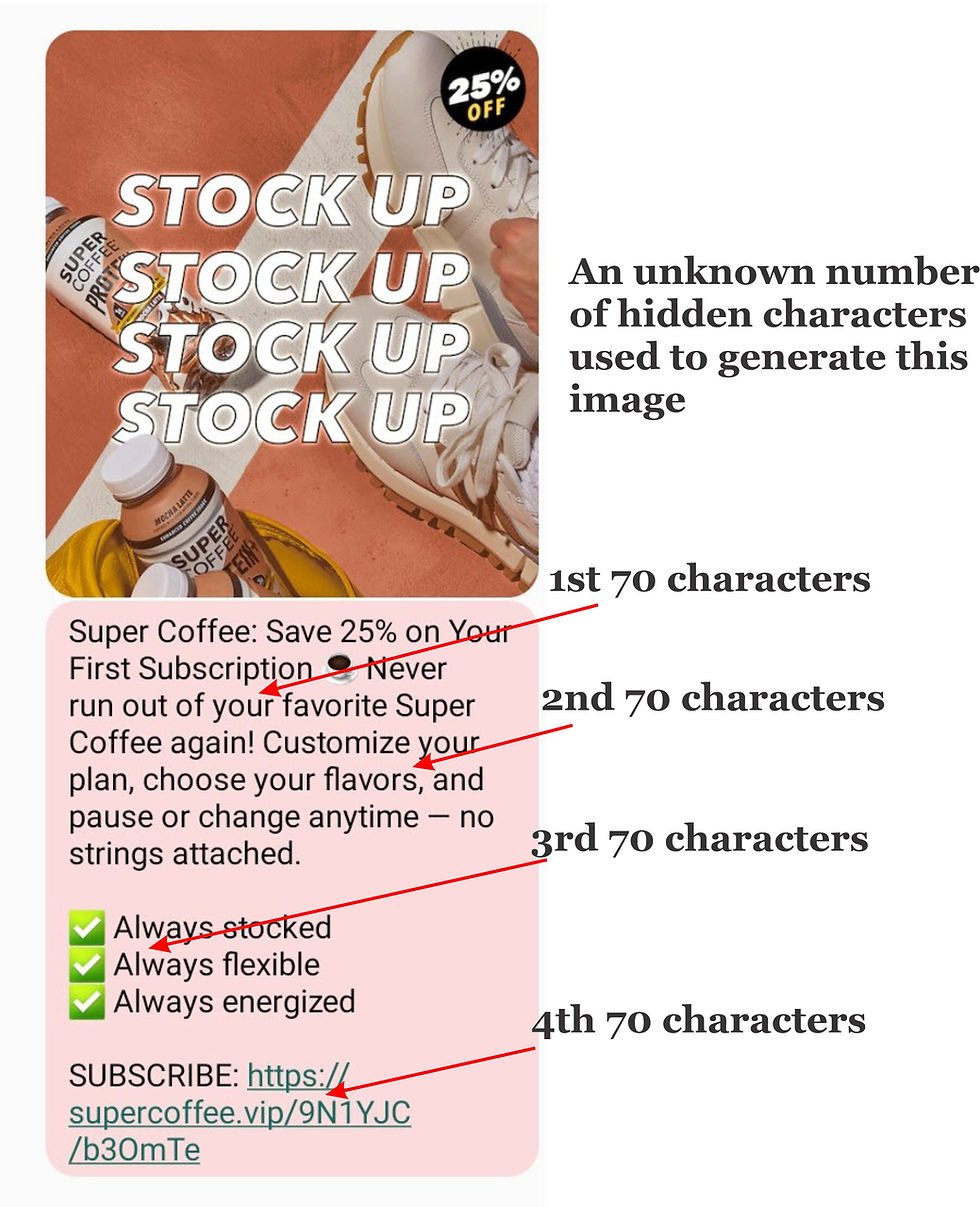
For example, under the TCPA, how many texts are in this example? The answer is, at least 5. We don't know how many characters was used for the link to generate the image, but the message uses emojis so every 70 characters is another text. There are over 280 characters, so this one block is at least 5 text messages under the TCPA and probably under your state law.
This issue recently came to court in Connor v. Servicequick Inc., 2025 U.S. Dist. LEXIS 199578, 2025 LX 416970.
Mr. Connor received 'one' text message that was 227 characters in length, and he sued under the TCPA under the argument that this was actually two text messages and he met the more-than-one-call-in-12-months of the TCPA 227(c). Servicequick moved to dismiss under the argument that anything that visually appears to be one (albeit long) text message is just one text message, and Mr. Connor really hadn't received more than one text message in a 12 month period.
The core argument advanced in ServiceQuik's dismissal motion is that Plaintiff fails to state a claim for relief under Section 227(c) of the Telephone Consumer Protection Act (TCPA) because despite pleading that Plaintiff received two text messages from Defendants while his phone number was listed on the national Do-Not-Call (DNC) registry, Plaintiff actually received only one text message that was approximately 227 characters in length. ServiceQuik argues that Plaintiff's phone records reflect the receipt of two messages due to "invisible technical processes" used to transmit text messages that exceed the standard, 160-character limit for SMS messages. ServiceQuik contends that despite these back-end technological processes, Plaintiff's TCPA claim fails because only one message actually "appear[ed]" on Plaintiff's phone, as evidenced by a screenshot submitted by Plaintiff in a related state-court action.
ServiceQuick explains the technology behind the 160 character limit texts.
SMS messages, when using the default GSM 7-bit character encoding, are technically limited to 160 characters per segment-a standard set in the 1980s when data transmission was less advanced. However, modern messaging technology makes this limit largely invisible to users. When a message exceeds 160 characters, devices and networks automatically split it into multiple segments using 'concatenated SMS,' which adds a small header to each segment so the recipient's device can seamlessly reassemble them [this is why a text message of 2 x 160 displayed characters on your phone must be three texts - a text message can't use the full 160 characters to display text on your phone]. While each segment is transmitted separately, the end user sees only one continuous message, exactly as the sender intended.
The court denied ServiceQuick's motion, and also cast shade on the usual telemarketing routine that the pro-se plaintiff has sued to many times to sue again.
Second, ServiceQuik argues that Plaintiff's TCPA claim should be dismissed pursuant to Rule 12(b)(1) for lack of Article III standing because by "fishing for telemarketing violations" and "effectively seeking TCPA lawsuits," Plaintiff "does not have the privacy interest that the TCPA is intended to protect" and "has not suffered an injury in-fact." In support of its argument, ServiceQuik contends that Plaintiff has previously "initiated hundreds of lawsuits in relation to telemarketing." This would perhaps be relevant if Plaintiff were alleging only a "generalized interest in punishing telemarketers," Leyse v. Bank of Am. Nat'l Ass'n, 804 F.3d 316, 323 (3d Cir.2015), or if Plaintiff had "admitted" that his "sole purpose" in purchasing his phone was to "receive more calls, thus enabling [him] to file TCPA lawsuits," Stoops v. Wells Fargo Bank, N.A., 197 F. Supp. 3d 782, 802 (W.D. Pa. 2016). However, that is not the case here.
Got a Case Like This?
If you’ve had similar problems with telemarketers, debt collectors, or bankruptcy-related harassment, we might feature your story in a future blog post. Email your situation or legal filing to peter@nwdebtresolution.com or nathen@nwdebtresolution.com.
Are telemarketers bothering you in Washington, Oregon, or Montana?
I handle TCPA lawsuits in Washington State and Oregon, and may be able to help.
📞 Call: 206-800-6000 / 971-800-6000
📧 Email: peter@nwdebtresolution.com
Note: The opinions in this blog are mine (Peter Schneider) and do not count as legal advice. If you're thinking of suing over illegal robocalls or Do Not Call list violations, contact me for a legal consultation.


Comments